Basketball Shooting Hand Placement: 3 Grips, Guide Hand, and Flow for a More Accurate Shot
Someone told you form doesn't really matter. So you're just going with what feels right. And the ball keeps clanking off the side of the rim.
Coach Meech hears that one a lot. His answer is pretty simple: clearly that's not working for you, so let's fix it. And he starts with the thing almost nobody teaches right. Where your hands actually go on the ball.
Below is his whole breakdown on basketball shooting hand placement, plus the body position, footwork, and flow that go with it.
Not sure your shot is the thing holding you back? Find your training strategy with our free training quiz.
Why "just shoot what feels comfortable" backfires
You grab the basketball however. A coach told you to shoot it the way it feels comfortable. So you've been practicing for years with your hands in all kinds of weird places, and now you're shooting it however, too.
Coach Meech isn't saying comfort doesn't matter. He's saying you need your hands in the proper spot first. Then you get comfortable inside that.
The 3 grip options for your shooting hand
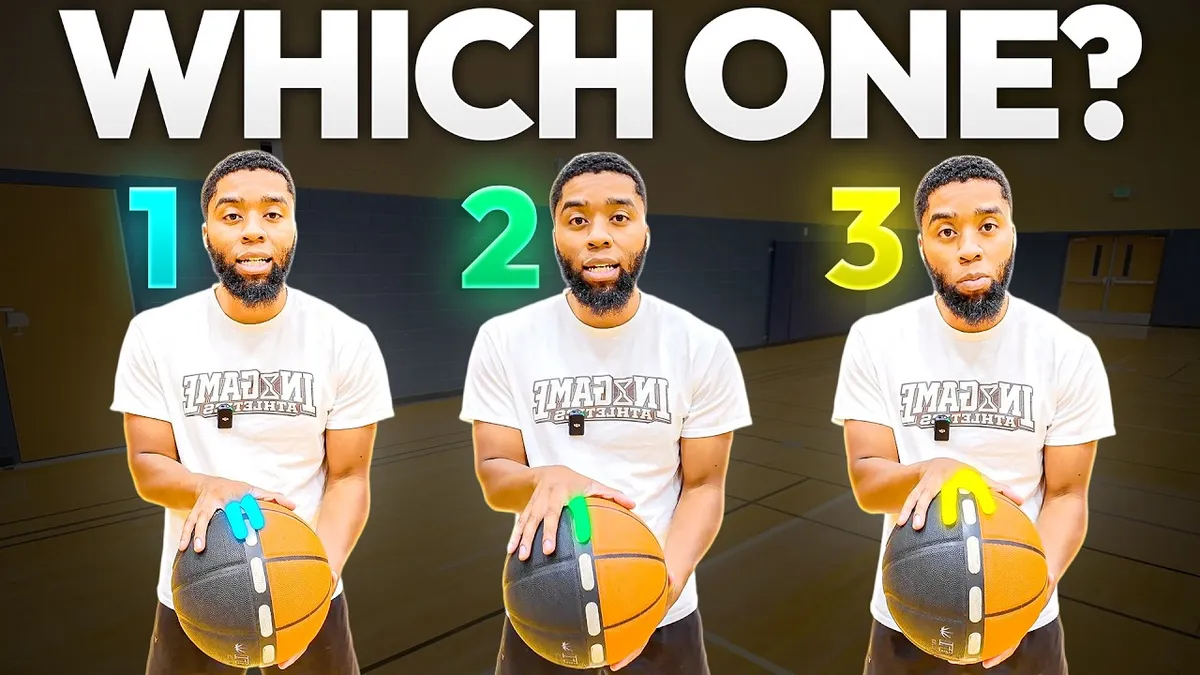
He uses a ball with a white line running down the middle, and that line is what makes this easy to see. Your shooting hand goes right down the middle of the ball. From there, you've got three spots to pick from:
Pointer finger down the middle. Put your pointer finger right on that white line.
Split grip. Let the white line split right between your fingers.
Two fingers on the line. Both fingers go straight down that line.
Which one does he use? Two fingers. "I like to have both my fingers strictly on that line because I can push through the ball with more control."
Where your guide hand goes
On his ball there's the white line, plus a logo going down the side. Once your shooting hand is set down the middle, you place your guide hand on the side of the ball. You can scoot it up so it's right on that white line for more control. Or scoot it down to where the logo sits.
What you don't want is to go too far below that logo. Now your hands get too close to each other, and that's where you start to lose your grip.
Keep it closer to the line.
Get your full hand on the ball
This is the part Coach Meech calls one of the most overlooked pieces of having better control.
A lot of players get told to keep a space, a little gap, between the ball and their hand. He says that actually promotes less control, because your full hand isn't on the ball.
What he wants is for the ball to sit a little flatter in your hand. You'll still have a bit of space, because that's just how your hand's built naturally. But now your whole hand is on it. Shooting hand down that white line, guide hand set on the side. Full coverage.
And once that's true, the ball can't slip off in any direction as you go through the rest of your shot.
How hand placement gives you backspin
When your hands are in the right spots (down the white line, guide hand where it belongs, full hand on the ball) the ball can actually spin the correct way when you shoot. That's backspin. And with good backspin, when the ball hits the rim, it drops straight down instead of bouncing away.
More on spin in our smart basketballs and backspin.
Keep the ball connected to your body
Hands are set. Now your body.
Instead of pushing the ball out away from you, keep it connected, close to your center of mass. That's what lets you be stronger when you move with it.
But close doesn't mean glued on. If the ball's actually touching your body, it's going to want to drag up your body as you shoot, and that feels really uncomfortable. Close, not too close.
The big mistake he sees: you get set in the right spot, connected, and then as you start moving through your shot you push the ball out, away from yourself, and bring it back in. That's wasted movement. The fix is to push the ball up first. You're nice and low, and the ball moves up. Now you get to use the fact that it's close to your center of mass, instead of having to redirect it and pull it back.
We cover more of these habits in jump shot mistakes too.
Footwork: stay on the balls of your feet
Your lower body has to be connected to the floor for real balance. Two ways players mess it up:
Going all the way to your toes. Now you're leaning everywhere and you can't create enough power.
Being flat-footed. Now making energy is a whole lot harder, because you have to recreate it by getting up to your toes.
So you want the middle. On the balls of your feet, where you can still pop and be quick, but not so far up on your toes that you're falling over.
The one time your heel goes first
Moving forward. Say you rip and go to the rim. On that first step of the one-two, you go heel first. On the second step with your other leg, you jam your toe into the ground. Heel first, toe second, then you lift. Same idea when you're moving forward into a pull-up.
Moving to the side? Stay on your toes. Drop nice and low, stay quick, pop off the floor.
Moving backwards? Land straight to your toes.
Flow into your shot off the catch
Last piece is flow. Coach Meech breaks it into two situations, and the first is catching a pass.
Say it's coming from the top of the key. Meet the pass with your hands. Don't sit there waiting for it with your hands back by your body, because catching it late throws off your rhythm. Meet it early, and that's when you start getting your hands in the right position, like we talked about up top.
Then don't break the ball's momentum. Once you meet it, keep it moving down. You dip the ball, your body dips, and then you bring it right back up. You're not stopping it. You're just redirecting it.
He sees players ruin this two ways:
They catch it, drop down, and then stop to figure out their hands. Momentum's gone and they have to restart it.
They dip and come up fine, then take a big pause at the top and have to recreate that energy.
One extra tip: on the dip, don't drop the ball so low your arms fully extend. Keep your arms kind of parallel to the floor and think about stopping it right around your belly button. Then push up and flow through the rest of the shot.
Flow off the dribble
When you get into your pull-up, you don't want to stop the ball and recreate the energy. He describes it as almost like a pass off the floor. You take that bounce and let the ball keep flowing right into your shot. So your pickup timing has to be really smooth.
Where most players struggle is the last dribble.
Sometimes it's way too far out. Then you've got to grab it and bring it in, and that kills your rhythm. You want the ball kind of attached to you, so when it bounces it comes straight back up and you keep flowing the same direction.
The other problem? You don't dribble hard enough. The ball doesn't come back up, so you reach for it and recreate energy again. Bounce it hard and you get more momentum from the floor going into your shot.
His timing tip for a pull-up going right: take that bounce with your inside leg. That's when you start picking the ball up. When your second foot hits, that's when everything starts going up into your shot. No extra steps that slow you down.
Making it your own
Coach Meech wants you to notice one thing. All of these tips are super customizable. They're guidelines and fundamentals, not one exact jump shot.
Hand placement? Pick what feels more comfortable. A little more on the white line, or down by the logo. Whatever fits you, you're still following a good system.
Ball position? Not touching your body, not too far away. Find your middle ground in there.
You still get to be comfortable. Just inside good principles.
If you want to keep building, check out our basketball shooting form drills workout, and our basketball shooting hacks.
Not sure what to work on next? Find your training strategy. It's a free training quiz.
FAQ
Where should my fingers go on a basketball when I shoot?
Right down the middle of the ball. Coach Meech gives three options: pointer finger on the center line, a split grip with the line between your fingers, or two fingers on the line.
Where does the guide hand go on a jump shot?
On the side of the ball. You can slide it up close to the center line for more control, or down a bit. Just don't go so low that your hands crowd each other, since that's where you lose your grip.
Should there be a gap between my palm and the ball?
A little, naturally. But Coach Meech says getting told to keep a big gap actually gives you less control. Let the ball sit a bit flatter so your full hand is on it.
Why does hand placement affect backspin?
When your hands are centered and your full hand is on the ball, it can spin the right way off your fingers. Good backspin means when it hits the rim, it tends to drop straight down.
How close should I hold the ball to my body?
Close to your center of mass, but not touching. If it touches, it drags up your body.
Should I shoot on my toes or flat-footed?
Neither. Stay on the balls of your feet. The heel only goes down first when you're moving forward, like the first step of a one-two.
How do I get better rhythm off the catch?
Meet the pass early with your hands, then keep the ball moving. Dip it down to about your belly button and bring it right back up without stopping to fix your hands or pausing at the top.
What should I work on after fixing my hand placement?
That depends on your game. Take the free training quiz and find your training strategy to see where to go next.