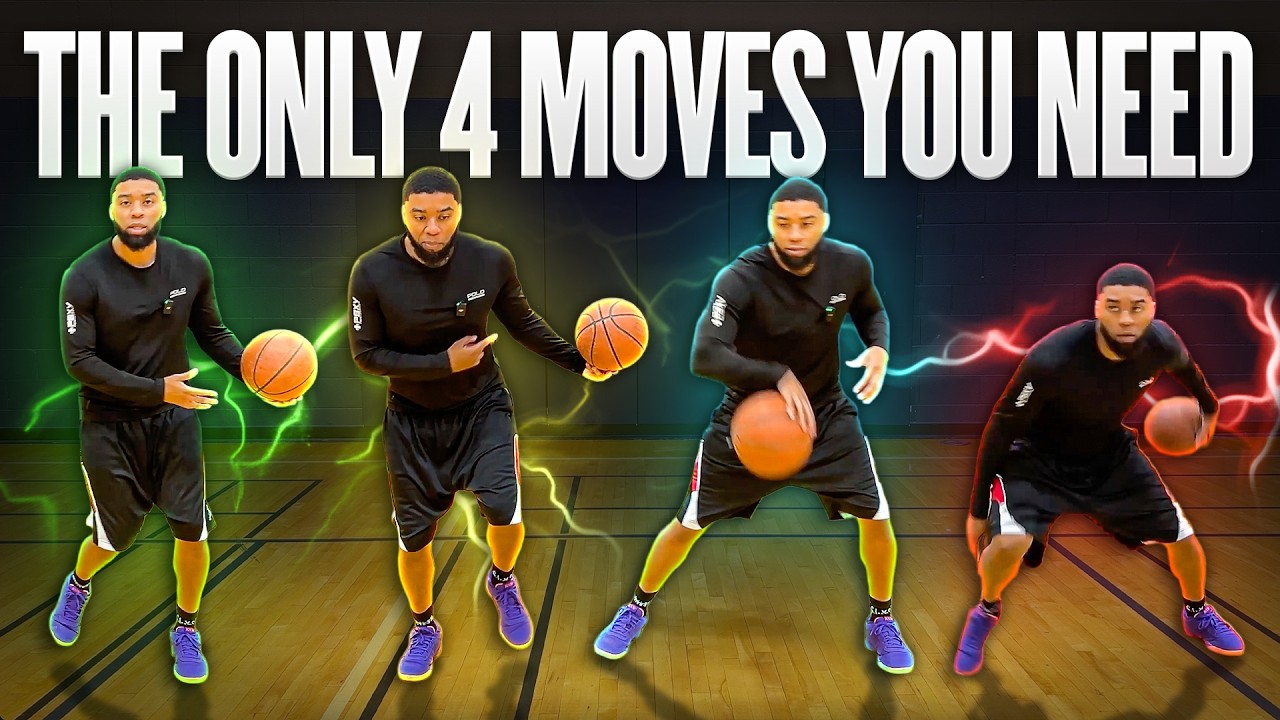
4 Dribble Moves to Beat a Defender (Coach Meech)
Dribble Moves to Beat a Defender: The Only 4 You Need
Most players burn hours learning 20 to 30 dribble moves. Then the lights come on and they freeze. Coach Meech from I Love Basketball TV keeps it simple: you do not need a crazy bag to break a defender down. You need a few go-to moves that work in real situations.
This post covers the four moves from the video, in order, with the footwork, shoulder cues, and when to use each one. Practice them slow, then at game pace. The goal is creating an advantage, not collecting highlights.
Move 1: Single-leg skip hesitation
Purpose: freeze the defender, then explode past them.
Setup and progression:
Get low. Start on one leg. Ball in your left hand means you stand on the opposite (right) leg.
2. Take a dribble.
3. Skip off that outside leg. The right leg skips backwards and flares out so the skip can push you out.
4. On the skip, pull the basketball back to your pocket.
5. Place the left leg down as your dig step and take off past the defender.
Full rhythm: dribble, skip, pocket, step, go.
Shoulder key: do not flare your chest up and lean back on the hesitation. When the chest pops up and back, you have to reload forward before you can sprint. Keep the shoulders neutral, or even slightly forward, so you can take off immediately.
This move is about freezing someone, not shoving them sideways. Sell the pause, keep your shoulders ready to run, and go.
Move 2: In-and-out dribble
Purpose: shift the defender out of your path so you can get to their hip and go downhill.
Hand part (one bounce):
Hands on the side of the basketball.
- Push the ball across the center of your body.
- Imagine a line down the middle of you. Break that line, turn the hand over, and push the ball out.
- One bounce only. Turn over, then push out.
Foot part (this is what sells it):
As the ball comes across, step in that same direction.
- Ball in the right hand? Jab the left leg to the left so the defender shifts.
- Hand-only in-and-outs do not move good defenders. Foot jab plus body shift does.
Shoulder tip: shift toward the jab side, but do not stay rigid like a perfect defensive slide. Dip the dominant shoulder. Ball in the right hand means the right shoulder gets ahead and the left shoulder comes back. That dip sells the fake crossover. Then take a big step with the other leg (right leg in that example) to get by.
When to use it: transition and change-of-pace spots. You can come full speed, hit the in-and-out, and create the shift. Hesitation freezes. In-and-out moves the defender out of your way.
For more change-of-direction ideas in the same lane, see [ankle-breaking basketball moves](https://ilbelite.com/post/ankle-breaking-basketball-moves). Keep building from these four first so your bag stays usable under pressure.
Move 3: Double behind-the-back (sit and wrap)
Purpose: protect the ball when a defender closes space, then create an advantage without flashing the ball in front for a steal.
Coach Meech calls this specific version a sit and wrap. You will see Steph Curry use a similar pattern. Here is the breakdown:
Sit (first behind the back)
Drop quick.
- Feet split wide.
- That sit gets the defender to sit with you.
- Go behind the back on the first pass.
Wrap (second behind the back)
Stand up.
- Take the ball and almost throw it ahead of you on the wrap.
Why it works under pressure: the first behind the back can make the defender back up or reach for a steal. The wrap then avoids them while the ball stays behind your body, not out in front. You get to the side of their hip and go downhill.
Beginner trap: when pressure hits, the most natural move is a front crossover. If the defender is sitting on your chest, that front cross is an easy steal. Protecting the ball behind your back is the skill. Adding the wrap turns protection into a beat.
Use this when someone is closing space and getting tight. Sit them down. Wrap past the reach.
If you want a longer handle plan after you own these four, [Hybrid Handles](https://ilbelite.com/hybrid-handles) is the program path on ILB Elite for players who need structure beyond a single workout video.
Move 4: Lift into a push cross
Purpose: beat a defender in an ISO with two dribbles, not seven.
The lift is a simple skip to the side. You can set it up a few ways:
Turn and lift (turn dribble with the hand turning over the top).
- Skip to the side.
- Cross in front, then lift.
Setup style is flexible. The money move is the push cross after you land.
Sequence:
Lift (example: turn and lift).
2. Land and drop to the floor as fast as you can.
3. Push cross: hand starts on the side of the ball, turns over the top, and pushes the ball across your body as you run past the defender.
4. Push off the back foot and sprint by.
Push cross vs regular crossover:
Regular crossover: hand stays on the side and works the ball back and forth.
- Push cross: hand starts on the side, turns over the top, and places the ball down on the opposite side as you attack.
ISO use case: one-on-one, you need a clean beat. Lift (defender may shift a little), drop, push cross, and you are gone. Two actions. Not a seven-dribble dance.
Bonus tip: counter when they read the push cross
Because you are running with the ball on the push cross, you still have time to see the defender shift. If they slide with you, stop and cross back the other way quickly. You can feel the bump, see the slide, and change direction. That counter sits on top of the same lift-into-push-cross base.
How to train these four without building a bloated bag
Work one move at a time before you chain them.
Single-leg skip hesitation until shoulders stay forward and the dig step is clean.
2. In-and-out until the jab foot and dominant-shoulder dip actually move an imaginary defender.
3. Sit and wrap until the first behind the back is a real sit and the second is a real wrap ahead.
4. Lift into push cross until the drop is fast and the hand turns over the top on the push.
Then add the push-cross counter. Film yourself. If your chest flies up on the hesitation, or your in-and-out is hands-only, fix that before you add speed.
Parents: these are game-situation moves, not circus dribbles. Ask your player which move they would use in transition (often in-and-out), under pressure (sit and wrap), in a freeze spot (skip hesitation), and in ISO (lift into push cross). That conversation beats collecting random YouTube moves.
Quick reference: which move for which problem
| Situation | Go-to move | What it does |
|---|---|---|
| Need to freeze someone | Single-leg skip hesitation | Pause, pocket, dig step, explode |
| Need to shift a defender | In-and-out | Jab + shoulder dip moves them |
| Tight pressure / reach risk | Sit and wrap double behind | Protects ball, then wraps past |
| ISO, need a quick beat | Lift into push cross | Two actions to get downhill |
| They read the push cross | Cross-back counter | Stop and change direction while running |
Keep the list short on purpose. Four moves you can trust beat thirty moves you forget.
Frequently Asked Questions
How many dribble moves do I need to beat a defender?
Coach Meechs point in this video is that you do not need 20 to 30 moves. Four go-to moves that work in real situations are enough: skip hesitation, in-and-out, sit-and-wrap double behind the back, and lift into push cross.
What is the key mistake on the skip hesitation?
Leaning the chest up and back on the hesitation. That forces you to reload forward before you can sprint. Keep shoulders neutral or slightly forward so you can take off right away.
Why doesn’t a hands-only in-and-out work?
Because the basketball moving alone does not shift a good defender. You need the jab foot in the same direction and a body/shoulder shift (including a dominant-shoulder dip) to sell it.
What does sit and wrap” mean on the double behind the back?
Sit: drop quick, feet split wide, first behind the back so the defender sits with you. Wrap: stand up and send the second behind the back ahead of you almost like a throw wrap to get past their reach.
When should I use the double behind the back instead of a crossover?
When the defender is closing space and getting tight. A front crossover in that spot is an easy steal. Behind the back keeps the ball protected, and the wrap creates the advantage.
What is the difference between a push cross and a regular crossover?
On a regular crossover the hand stays on the side of the ball. On a push cross the hand starts on the side, turns over the top, and pushes the ball across as you run past the defender.
How many dribbles does the lift into push cross take to create an advantage?
In the video Coach Meech frames it as about two actions: the lift, then the drop into the push cross. It is built for ISO situations where you do not want a long dribble dance.
What is the counter if a defender reads my push cross?
Because you are running with the ball, you can still see them shift. Stop and cross back the other way quickly. Feel the bump or see the slide, then change direction.
Stay low, sell with your feet and shoulders, and protect the ball when pressure comes. Coach Meech and I Love Basketball TV / ILB Elite will keep the bag small so it shows up when the lights are on.
Four moves you can trust beat thirty moves you forget. Want a plan built around your game? Answer four quick questions for your training focus, three free videos, and a program recommendation.
Find your training